


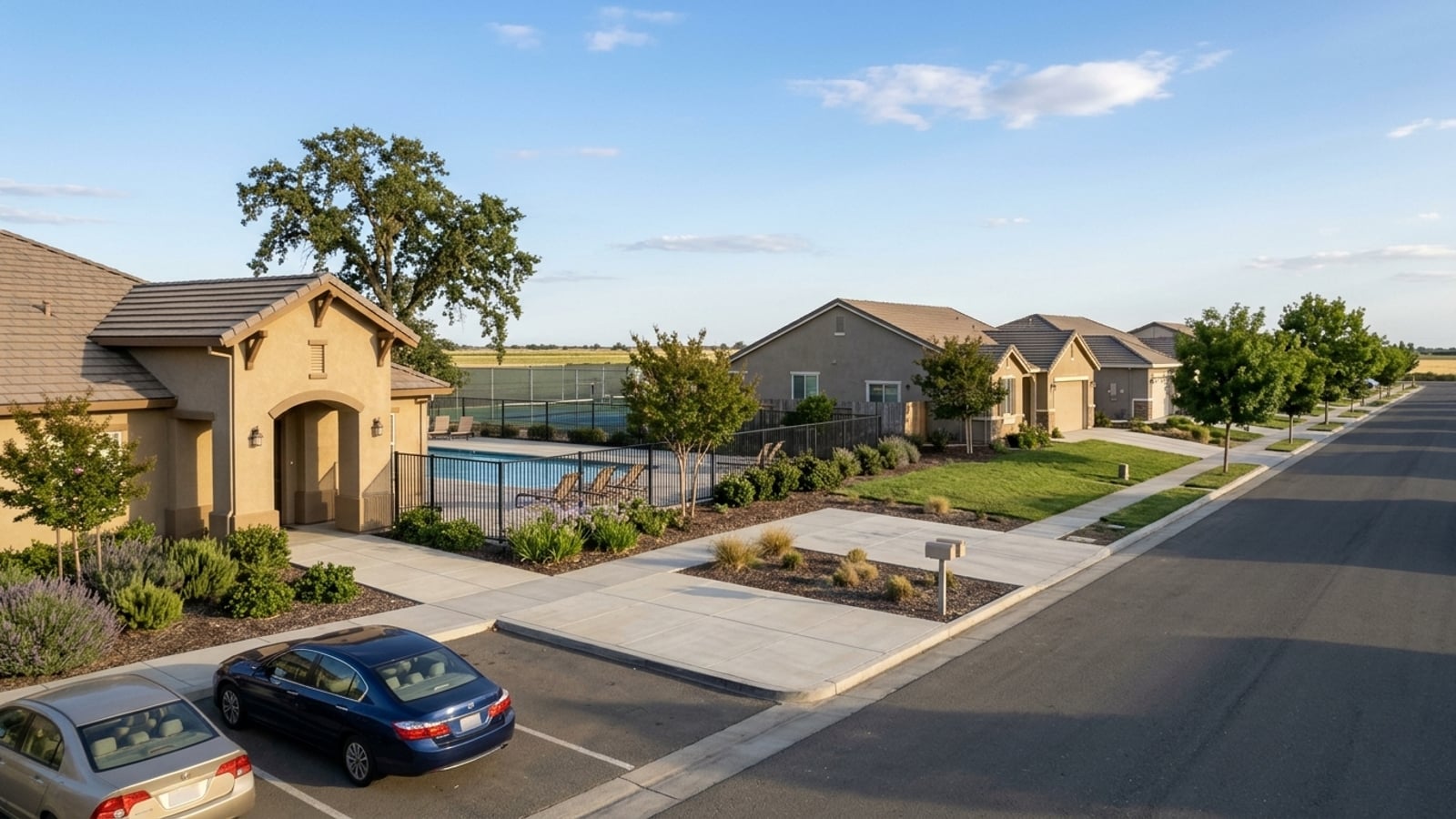
Moving into a retirement setting in Sacramento means choosing between three fundamentally different things: buying a low-maintenance home, renting an apartment with bundled services, or signing a contract that includes future care. That choice comes down to how you want to deploy the equity from your current house and whether you'd rather own real estate or pay for someone else to manage it.
Sacramento has options across all three paths, from age-restricted 55+ neighborhoods to continuing care campuses to independent living rentals. Each one carries distinct upfront costs, monthly fees, and legal rules that govern who can live there and what happens when you eventually leave.
Key takeaway
If you're selling a Sacramento house to fund a retirement move, owning is the stronger financial play right now. You can sell a single-family home into a fast market, then buy a condo, townhouse, or 55+ community home where prices have softened over the past year, which gives you room to negotiate. If you'd rather trade your home equity for services and future care, a continuing care community or an independent living rental is the alternative.
Who this guide is for
You're weighing whether to sell a Sacramento-area house and move into a 55+ community, a smaller condo or townhouse, or a rental or care community, and you need to know what each one costs and commits you to.
The Sacramento retirement housing market right now
A Sacramento retirement move spans two markets heading in opposite directions. The single-family house you're selling goes in a median 29 days, with about 33.4% of properties selling above list price. The condo you might buy sits for a median 71 days with roughly 4.9 months of supply (Redfin, 30 days ending 2026-09-30).
If you're downsizing into owned retirement housing, price your sale firmly and skip the deep pre-listing discounts. On the purchase side, negotiate hard: ask for concessions, repairs, or a straight price reduction. These figures cover the city as a whole for a single month, and many large age-restricted communities sit outside city limits. You can review the broader Sacramento housing market and the current housing market forecast to see how these trends are shifting.
Buying a home in a retirement community
Purchasing a home keeps your equity working for you and gives you complete control over your living space. You can make modifications as you age, and you avoid the annual rent resets that come with independent living facilities or the large entrance fees required by continuing care campuses.
The trade-off is that you take on HOA dues and the responsibility of eventually selling the property. Whether you choose a neighborhood with strict age rules or a standard low-maintenance attached home, monthly fees and future resale conditions both belong in your budget from the start.
55+ active adult communities
These are owned single-family homes or attached properties in age-restricted developments that typically feature a clubhouse and are managed by an HOA. The age rules come from the federal Housing for Older Persons Act and California's own senior-housing laws. The federal Housing for Older Persons Act requires that at least 80% of occupied units have at least one resident who is 55 or older, so a community can legally allow some younger households if its specific rules permit it.
Each community's Covenants, Conditions, and Restrictions (CC&Rs) set the exact details on who can live with a qualifying resident. Because most of these communities sit outside city limits, the citywide market figures don't describe them accurately, and you should ask for recent sales data from inside the specific gates. Some new 55+ phases are currently builder-sold, so it's worth checking local new home developments.
What you give up is a broad resale market. Your future buyer pool is limited to households that meet the age rule, and you'll pay HOA dues that cover amenities whether you use them or not.
Condos and townhouses without an age rule
If you want the most negotiating room on the home you buy, condos without an age rule are worth a close look. Sacramento condos recently closed at a median 97.5% of list price, which means buyers have room to ask for a lower price or seller credits. Townhouses offer more space per dollar in a low-maintenance attached format, selling for about $276 per square foot compared to $306 for condos (based on a small sample of 32 recent townhouse sales).
These are standard homes that anyone can purchase, so resale isn't limited by a buyer's age. Review typical HOA fees to understand your monthly carrying costs. If you plan to finance the purchase, check whether the condo project has current FHA approval on HUD's online lookup tool.
One caution: the slower market helping you buy will work against you if you need to sell again soon. Ask the HOA for the reserve study and any planned special assessments before you commit, because a thin reserve account can produce a large, unexpected bill.
Renting or paying for care services
Moving into a rental or care community means trading your home equity for bundled services, meals, and future support. Property maintenance disappears from your list of concerns entirely.
Because you're buying into an operating business rather than a piece of real estate, the contract documents matter more than the floor plan. You'll need to evaluate monthly rate histories, entrance fee structures, and licensing records before you sign anything.
Independent living communities
These are rental apartments or cottages where meals, activities, and transportation are bundled into a single monthly fee. Costs depend entirely on the operator, so request a current rate sheet directly from the facility rather than relying on broad estimates. This model frees up the cash from your current house while removing day-to-day property management from your plate.
What you give up is equity, and your rent resets every year. Before you sign a lease, ask for the last three years of rent increases and a list of services billed separately.
Continuing care retirement communities
A continuing care retirement community (CCRC) provides independent living now and access to higher care levels later, all on one campus. You pay an upfront entrance fee plus monthly fees.
California regulates these contracts through the Department of Social Services, and you can confirm a provider holds a permit while reviewing their disclosure statement. California law gives you a window after signing a continuing care contract to cancel and get your money back without cause within 90 days of moving in.
The entrance fee is the largest single outlay among all these options. How much of it comes back to you or your estate depends entirely on the specific contract type you choose, so read the refund terms carefully.
Assisted living and memory care
These are licensed care settings, specifically Residential Care Facilities for the Elderly in California, rather than housing purchases. Every licensed assisted living facility in California has a public record of inspections and citations you can search online through the Community Care Licensing Division. You can look up a facility's license status, capacity, and complaint history before you visit.
Pricing is typically tiered by care level, so the monthly cost can rise as your needs change. Ask for the full level-of-care price sheet, not just the base rate.
How selling your house funds the move
Selling a single-family house first and then buying an attached home is the most direct way to free up cash from your current property. If you sell at the citywide single-family median of roughly $603,555 and buy at the condo median of about $340,054, you're left with approximately $263,501 before costs. Deduct seller closing costs and commissions on the sale, then add buyer closing costs on the purchase.
The remaining cash can fund a CCRC entrance fee or cover several years of independent living rent, though you should compare that against actual rate sheets from local operators. Homeowners 55 and older may also be able to carry their current property tax base to the new home under Proposition 19, up to three times in a lifetime, using a form filed with the county assessor. Confirm your eligibility with the Sacramento County Assessor and review how local property taxes work.
Timing the transition matters. Review how long it takes to sell before committing to a move-in date elsewhere. Johnny Jennings can pull recent sales inside a specific community so your financial estimates reflect that exact neighborhood instead of the city as a whole.
How to choose a Sacramento retirement community
Narrowing down your options starts with deciding what type of legal and financial arrangement fits your retirement plan: own real estate, rent an apartment, or buy a contract that guarantees future medical care. Once you settle on the type, you still have to vet the specific property or facility. The rules, fees, and financial health of the operator will shape your daily experience and your long-term costs. Reviewing the pros and cons of living in Sacramento can help you decide if the area fits your long-term plans.
Questions that narrow the list
Start with the most basic question: do you want to keep owning real estate, or would you rather trade your home equity for services and meals? If you want to keep your cash invested and avoid a large upfront purchase, an independent living rental makes sense.
From there, decide whether you want care available later without moving again. If yes, look into continuing care retirement communities. If you're comfortable relocating later if needed, compare independent living with assisted living separately.
Finally, ask whether the community has to be age-restricted or whether any low-maintenance attached home would work. Condos without an age rule offer the most negotiating room; townhouses give you more space per dollar. Narrowing the type is only half the work. Two communities of the same type can differ widely on fees, rules, and contract terms.
What to check before you sign
A community's age rule lives in its CC&Rs. California's senior-housing statute can be stricter than the federal threshold, so read the documents to see who may live with a qualifying resident. For owned homes, ask the HOA or management company for current dues, the latest reserve study, and any planned special assessments. If you're evaluating an area, you can review local safety data to understand the surrounding neighborhood.
For rentals and care facilities, ask independent living operators for the last three years of rent increases and a list of services that cost extra. Ask a CCRC for its disclosure statement and entrance-fee refund terms in writing, and look up any assisted living license on the state's Community Care Licensing site.
These documents are long and usually arrive during short contingency periods, so request them before you remove contingencies. Johnny Jennings can help you secure recent sales data inside specific communities so you know exactly what homes are worth there.
At a glance
- Single-family homes, City of Sacramento (30 days ending 2026-09-30): median sale price $603,555, up 1.4% year over year; median 29 days on market; 33.4% sold above list; 99.5% sale-to-list; 2.8 months of supply; $339 per sq ft; 1,653 sales.
- Condos, City of Sacramento (30 days ending 2026-09-30): median sale price $340,054, down 4.2% year over year; median 71 days on market; 97.5% sale-to-list; 12% sold above list; 4.9 months of supply; $306 per sq ft; 103 sales.
- Townhouses, City of Sacramento (30 days ending 2026-09-30, based on 32 sales, so read with caution): median sale price $376,961, down 5.8% year over year; median 66 days on market; 97.6% sale-to-list; 14.7% sold above list; 3.9 months of supply; $276 per sq ft.
- All homes, City of Sacramento (30 days ending 2026-09-30): median sale price $597,628, up 2.2% year over year; median 37 days on market; 3 months of supply; 5,372 homes for sale.
- Note to writer: state that these are citywide Redfin figures for one month of sales. They are not prices inside any specific 55+ or senior community.
Sacramento retirement communities FAQs
How much does a retirement community cost in Sacramento?
It depends on the type of community and the level of care you need. There's no public benchmark for independent living rentals or assisted living facilities, so request rate sheets directly from local operators to compare monthly costs. For continuing care retirement communities, review the specific entrance fee structures and monthly contract costs.
What is the 80/20 rule in a retirement community?
The federal Housing for Older Persons Act sets this threshold. California civil law also defines a senior citizen as 62 or older, or 55 or older in specific developments with at least 35 units. Read the community's CC&Rs to understand its actual policy on co-residents.
What is the downside of living in a retirement community?
It depends on the arrangement you choose. For owned communities, you take on HOA dues, potential special assessments, and a resale pool limited to age-qualified buyers. For rentals, your rent resets annually and you build no equity. Continuing care communities require entrance fees with varying refund terms.
What is the cheapest way to live in retirement in Sacramento?
It depends on whether you plan to own or rent. For buyers, an attached condo or townhouse costs less than a single-family house, freeing up more equity from your sale. For lower-cost rentals, the Sacramento Housing and Redevelopment Agency occasionally opens waitlists for project-based voucher elderly housing, such as the one-bedroom downtown units for residents 50 and older, so ask properties about their current waitlist length.
How old do you have to be to live in a 55+ community in California?
It depends on the community's specific legal structure. The minimum qualifying age is 55 in communities governed by the federal Housing for Older Persons Act, while other communities may require residents to be 62 or older. Care communities set their own admission criteria, so confirm the minimum age and co-resident rules in the CC&Rs or admission agreement.
Is Sacramento a good place to retire?
Yes, if you're looking for a housing market with varied options and softening attached-home prices. The citywide median sale price for all homes is roughly $597,628 with 3 months of supply, and condos and townhouses offer lower entry points. You can review the local cost of living and local weather to see how the broader lifestyle fits your plans.
What is the average entrance fee for a CCRC in California?
It depends on the facility and the contract type you choose. Request the disclosure statement and fee schedule from each permitted provider, which you can find through the California Department of Social Services' Continuing Care Contracts Branch. The refundable share of the entrance fee changes your effective total cost, so that detail belongs in any comparison you make.
Sources
- Redfin: Data Center
- Code of Federal Regulations: 24 CFR Part 100, Subpart E
- California Legislative Information: Civil Code Section 51.3
- California Board of Equalization: Proposition 19
- California Legislative Information: Health and Safety Code Section 1788.2
- California Department of Social Services: CCRC Providers
- California Department of Social Services: Care Facility Search
- Medicare.gov: Long-Term Care
- California Department of Health Care Services: Assisted Living Waiver
- Sacramento Housing and Redevelopment Agency: Waitlist Notice
- HUD: FHA-Approved Condominium Projects
Check out this article next