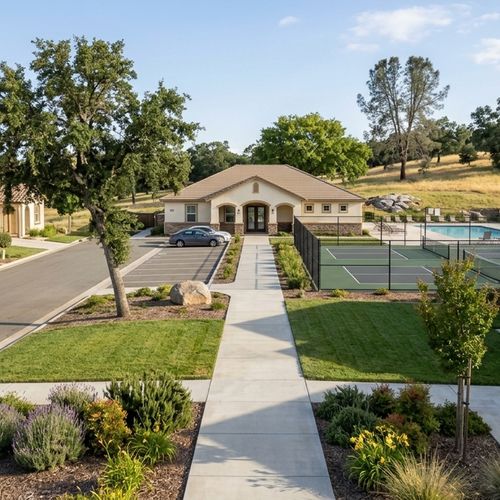


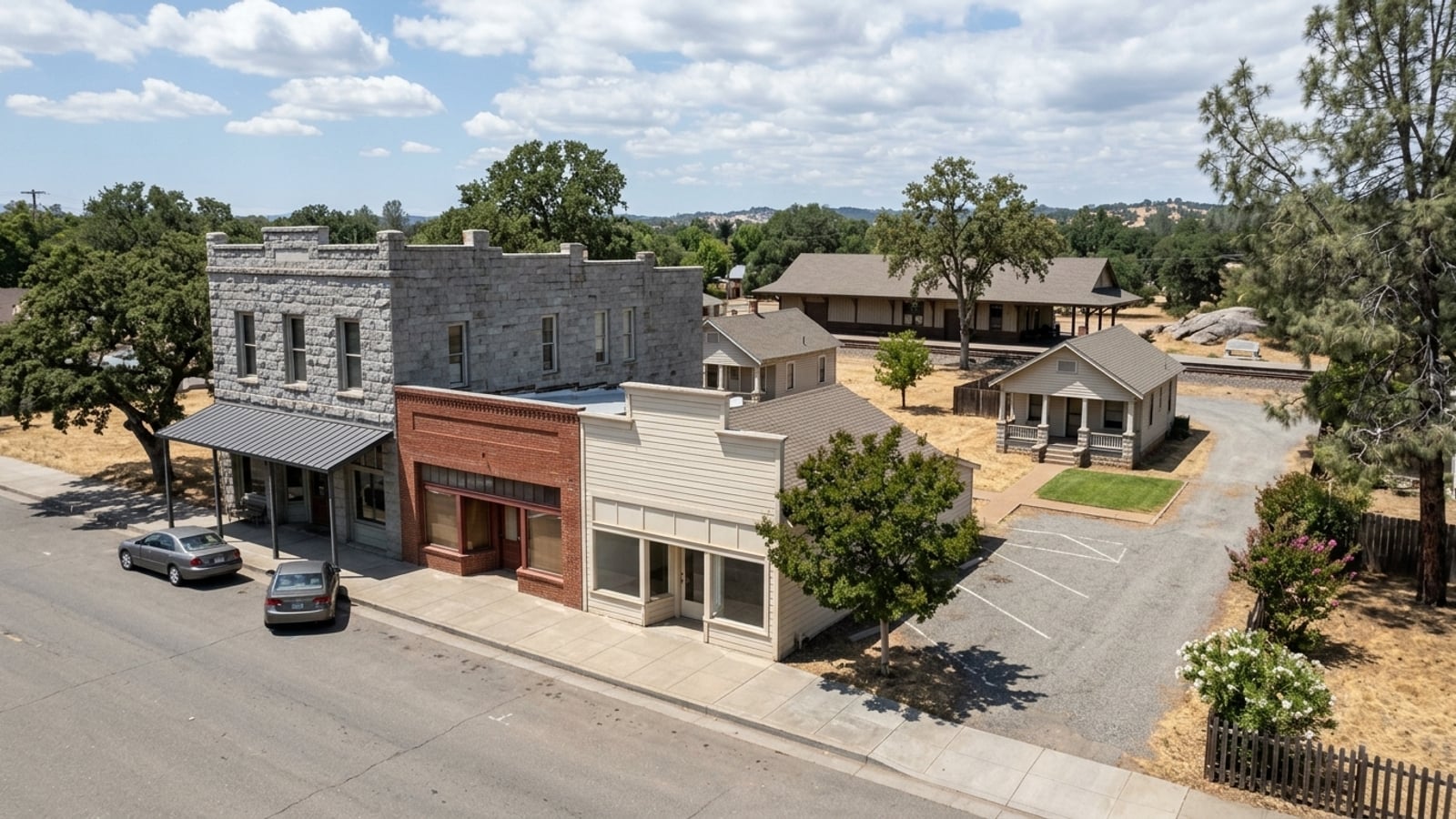
Rocklin sits in Placer County along Interstate 80, between Roseville and Loomis. The neighborhoods look like a modern suburban hub, but the streets near the center tell a different story about how this place developed.
The city's growth timeline explains why certain property types dominate the local market today. The development timeline is what determines whether you'll find a century-old house near the train depot or a 2010s build in a master-planned community.
Key takeaway
Rocklin began in 1864 as a Central Pacific rail stop and granite-quarry town, incorporated in 1893, and stayed small after its railroad roundhouse moved to Roseville in 1908. Most of the city you see now was built in master-planned neighborhoods from the 1980s onward. That's why today's market is almost entirely single-family homes, with 172 of 187 sales in the 90 days ending September 30, 2026. If you want historic character instead, you can look at the small original town near Quarry Park, but expect very few listings.
Who this guide is for
You're curious how Rocklin came to be, or you're weighing a move and want to know how the city's past shaped where and what you can buy.
Rocklin history in brief
Rocklin's story is a granite-and-railroad town that stalled when the Central Pacific roundhouse left for Roseville in 1908, then grew almost entirely through master-planned subdivisions from the 1980s on. Most of the residential streets spreading out from that highway corridor didn't exist fifty years ago.
That uneven timeline shapes everything about the current real estate market. Out of 187 residential sales in the 90 days ending September 30, 2026, 172 were single-family homes and only 11 were condos. Historic Rocklin is mostly something you visit at Quarry Park rather than something you can readily buy into.
Rocklin history timeline
Rocklin's physical layout developed in three distinct phases, leaving a gap of several decades where almost nothing was built. The initial boom brought industry and a downtown layout, followed by a long quiet period that preserved the original footprint.
Eventually, a late-century population surge reshaped the map completely. Each of those eras left behind specific types of neighborhoods and infrastructure that residents still use today.
Railroad and granite years (1864 to 1908)
The Central Pacific Railroad reached the area in 1864, extending its track southwest from Newcastle. That same year, the Capitol Quarry opened, supplying granite for the California State Capitol Building in Sacramento. The town grew quickly around the train depot and the quarries and incorporated in 1893.
Many early residents were Finnish immigrants who worked the quarries, and in 1905 they built the Finnish Temperance Hall using donated local granite. This era also carried a much darker chapter: on September 15, 1877, citizens destroyed the local Chinatown behind the roundhouse and barred Chinese residents from renting homes or working in the town.
The whole town rested on one railroad decision and one industry. That dependence set up a massive economic slowdown in 1908.
Quiet decades after the roundhouse left (1908 to the 1970s)
In 1908, the railroad moved all roundhouse operations to nearby Roseville, taking the jobs with it and permanently closing the Rocklin facility. Quarrying declined at the same time, and Rocklin stayed a small town for decades. The main mid-century change came when Sierra College opened its 311-acre Rocklin campus in 1961, bringing 1,500 students to the area.
So little was built during these years that very few pre-1950 homes survive today. According to 2017 American Community Survey data, only 17% of Rocklin's housing units were over 50 years old, and roughly two-thirds were built since 1990. That lack of mid-century construction is the root of today's thin supply of historic houses.
Master-planned growth (1980s to today)
Starting in the 1980s, large planned communities like Stanford Ranch, Sunset Whitney, and later Whitney Ranch turned former ranch land into subdivisions. Whitney Ranch and Whitney Oaks take their names from Joel Parker Whitney's 19th-century Spring Valley Ranch, which once covered 27,000 acres. This building boom multiplied the population, which grew from 7,344 in the 1980 Census to 71,601 by 2020.
Newer phases are still building today, which you can read about in the new home developments guide. Many of these neighborhoods were funded through community facilities districts and homeowners associations, and that's reflected in your monthly costs. Many newer homes carry costs beyond the base property tax, which you can review in the guide to Mello-Roos and property tax math.
Historic sites you can still visit in Rocklin
You can trace the city's past by visiting the original town site and the remnants of the Whitney estate. The route starts near the train depot, where the modern station is modeled on historic prototypes. From there, you can walk to Quarry Park and the former quarry pit, then continue to the Rocklin History Museum.
Nearby, you'll find Finn Hall, the 1905 Finnish Temperance Hall that now hosts the Rocklin Community Theater, and Old St. Mary's Chapel. Further out, near the Whitney Oaks Golf Course's 11th green, sits the Whitney family's pyramid-shaped tomb built around 1913. There's also the Clover Valley Bridge, one of 12 granite bridges built in the mid-1880s to connect the Spring Valley Ranch to downtown.
Confirm Rocklin History Museum hours with the Rocklin Historical Society before visiting. For non-history outings, check the things to do guide.
What Rocklin's history means for home buyers
The city's uneven growth timeline creates two very different housing markets. You'll generally have to choose between a handful of older properties near the original train tracks or thousands of newer homes in the northern and western subdivisions.
Because the master-planned areas dominate the inventory, the overall market behaves like a modern suburb. Single-family homes recently showed a 98.9% sale-to-list ratio and 2.8 months of supply, meaning the market is close to balanced. Most homes sell near their asking price, but about a quarter still go over.
Older homes near the original town site
The original town site centers around the depot, Front Street, and Rocklin Road, where James Bolton subdivided his farm in 1866. Today this area is known as the Quarry District, which is the closest thing Rocklin has to a historic downtown. It's where Rocklin started in 1864, more than a century before most of the city was built.
Listings here are rare, and older homes can mean older systems. Ask the seller for permit history and the sewer lateral condition, and order a foundation inspection. You should also ask the City of Rocklin planning department whether a property has any historic designation that limits exterior changes, as parts of Front Street fall under a Historic District zoning map.
Homes in the master-planned neighborhoods
The master-planned communities offer the widest selection and newer construction. This is where most of the 172 recent single-family sales happened. The single-family median sale price recently sat at $739,705, down 1.4% year over year.
That slight dip gives you modest room to negotiate rather than a steep bargain. What you give up is a lower tax bill, as many of these neighborhoods carry Mello-Roos special taxes and HOA dues that add meaningfully to your monthly cost. Check the property tax bill for CFD charges and ask the HOA for current dues, what they cover, and the reserve study.
You can review the HOA fees guide to compare these ongoing costs, and the types of homes guide to see how single-family properties compare to other options.
Where to start your search in Rocklin
Where you should look comes down to your budget and your preference for historic character versus modern convenience. The pros and cons of living in Rocklin can help you weigh these daily trade-offs.
If you want historic character and a walk to Quarry Park and the depot, start with the original town site around Front Street and Rocklin Road. It's where the 1864 town began and where most of Rocklin's surviving older buildings are, though listings are rare. If you want the widest choice of newer single-family homes, start with the master-planned neighborhoods such as Stanford Ranch, Sunset Whitney, and Whitney Ranch. Single-family homes made up 172 of 187 sales in the 90 days ending September 30, 2026, and that median gives you modest room to negotiate. If you want the lowest entry price and more time to decide, start with Rocklin's small condo market. The condo median was $349,964 with 5.4 months of supply, though that rests on only 11 condo sales.
If you'd like help comparing homes in the original town with newer areas, Made 4 More Realty can walk you through current listings. You can also consult the relocating guide to plan your timeline.
To narrow down your options, ask yourself a few questions:
- Do you want an older home within walking distance of the depot and Quarry Park, or newer construction with more homes to choose from? If older, read about the original town site; if newer, focus on the master-planned neighborhoods.
- Are you comfortable paying a special tax (Mello-Roos) or HOA dues in exchange for newer streets, parks, and homes? If not, check the property taxes guide before you shortlist the newer subdivisions.
- Is a condo near the $350,000 range on your list? If so, note that condo inventory is very limited, resting on just a handful of recent sales.
- Do you mainly want to visit Rocklin's history rather than live in it? Then the historic sites route is all you need.
At a glance
- All homes median sale price: $721,406, up 0.9% year over year (90 days ending Sept. 30, 2026)
- Single-family median sale price: $739,705, down 1.4% year over year (90 days ending Sept. 30, 2026)
- Homes sold: 187 total, 172 of them single-family (90 days ending Sept. 30, 2026)
- Single-family median days on market: 32; sale-to-list ratio 98.9%; 25.4% sold above list (90 days ending Sept. 30, 2026)
- Single-family months of supply: 2.8, with 156 homes in inventory (90 days ending Sept. 30, 2026)
- All homes median price per square foot: $326 (90 days ending Sept. 30, 2026)
- Condo median sale price: $349,964, down 6.5% year over year, based on just 11 condo sales (90 days ending Sept. 30, 2026)
- Condo months of supply: 5.4; median days on market 34, based on just 11 condo sales (90 days ending Sept. 30, 2026)
Rocklin history FAQs
What is Rocklin, CA known for?
Rocklin is known for its granite quarrying and the railroad, and today for Quarry Park. The city's Capitol Quarry, which opened in September 1864, supplied granite for the California State Capitol Building.
How did Rocklin get its name?
The city's name first appeared in print in June 1864 on a Central Pacific Railroad timetable. The exact origin remains debated among local historians, with a local news account noting that one theory suggests it was common railroad practice to name stations for locally famous people. No official government source definitively documents the origin.
Is Rocklin part of Placer County or Sacramento?
Rocklin is in Placer County, not Sacramento County. The county seat is Auburn, approximately 12 miles northeast of Rocklin by road. The city sits about 22 miles northeast of Sacramento, and you can check the commute times guide for drive and rail details.
Does Rocklin have a downtown?
The historic core around the depot and Quarry Park, known as the Quarry District, is the closest thing to a traditional downtown. The city envisions this district as a safe, walkable destination centered around Quarry Park. New development here is encouraged to honor the historic character while adding modern gathering spaces.
What is the population of Rocklin, CA?
According to the U.S. Census Bureau, Rocklin's population was 71,601 as of the 2020 Census. The city grew rapidly late in the century as master-planned communities expanded. Historical Census Bureau figures show the 1980 population was just 7,344.
Why are homes in Rocklin so expensive?
Home values are driven by a housing stock dominated by newer single-family homes built since the 1980s. The all-homes median sale price was $721,406, up 0.9% year over year, with a median price per square foot of $326 for the 90 days ending September 30, 2026. You can review the home prices guide for a deeper look at current costs.
When was Rocklin Elementary School built?
Rocklin Elementary School opened in 1952, when it was the only school in the district, serving students from kindergarten through eighth grade. A new gymnasium and underground irrigation system were added in 2003. To see which school serves a specific address, check the Rocklin Unified School District school locator.
How far is Roseville from Rocklin?
Rocklin is about 6.1 miles northeast of Roseville in the Sacramento metropolitan area. The two cities' histories are closely tied, as Roseville grew in large part because the railroad roundhouse moved there from Rocklin in 1908.
Sources
- City of Rocklin: About Rocklin
- Placer County Local Agency Formation Commission: City of Rocklin
- Union Pacific: Rocklin, CA
- City of Rocklin: Historic Sites
- City of Rocklin: Quarry District
- Roseville Today: Where did Rocklin come from?
- City of Rocklin: Rocklin's Chinese American Legacy
- Sierra College: Timeline
- Rocklin Historical Society: The Crowd in the Pyramid
- California Department of Housing and Community Development: Rocklin Housing Element
- U.S. Census Bureau: Rocklin City, California
- Rocklin Historical Society: Newsletter October 2017
- City of Rocklin: Land Use Element
- Rocklin Unified School District: Rocklin Elementary SARC
- Wikipedia: Placer County, California
- Redfin: Data Center
Check out this article next