


Explore accurate listings with the Made 4 More app and discover opportunities to make homeownership more affordable. Search smarter and find your dream home today! 🔗
Between home prices, interest rates, closing costs, and moving expenses, buying a home can feel like juggling five bills at once. Even when you find a property you love, the monthly payment can make you second-guess everything.
But what if there were a way to lower your mortgage payments without waiting for interest rates to drop?
There is. It's called a mortgage rate buydown, and it could give you more breathing room when buying your next home.
Let's break down how it works, the different options available, and how you could use it to make your next home more affordable.
What Exactly Is a Mortgage Rate Buydown?
Think of a mortgage rate buydown as a way to get some financial breathing room.
Normally, the higher your mortgage interest rate, the higher your monthly principal and interest payment. A rate buydown helps reduce that payment by using money upfront to subsidize a lower interest rate or payment.
Here's where it gets interesting: You don't always have to pay for it yourself.
Depending on the loan program, negotiations, and applicable limits, a seller or homebuilder may agree to cover the buydown cost as part of the transaction.
That means you could potentially secure a lower initial mortgage payment without having to wait for market rates to improve.
There are two main types of mortgage buydowns, and choosing the right one depends on your financial goals.
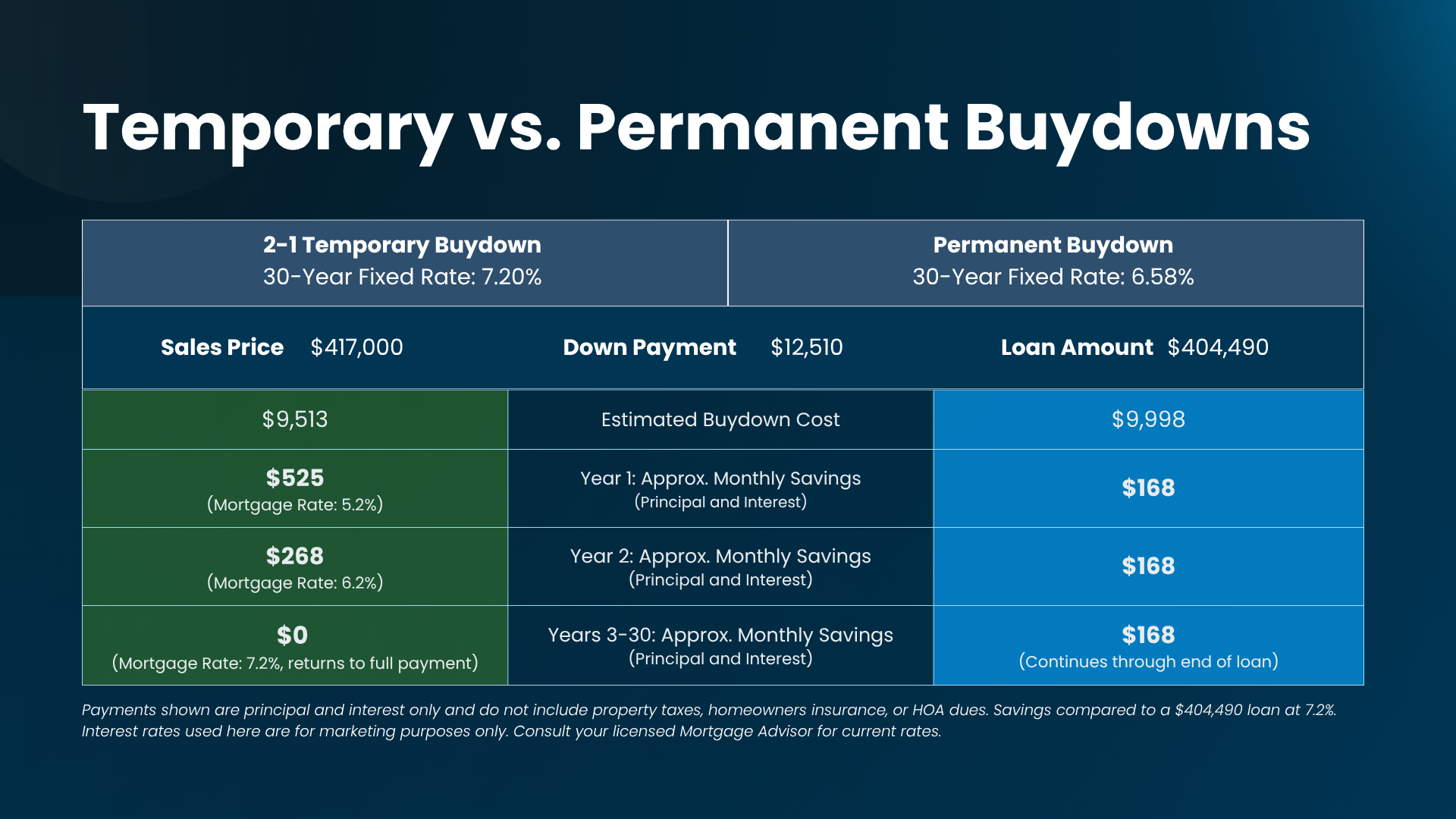

Temporary Buydowns: Lower Payments When You Need Them Most
Moving into a new home comes with plenty of expenses. Furniture, repairs, utilities, moving services—you name it!
A temporary buydown can help ease that financial pressure during your first few years of homeownership.
Here's how it works:
Money is deposited into a designated account at closing to cover part of your monthly mortgage payment during the buydown period. Your actual note rate doesn't change; instead, the funds subsidize your payments temporarily.
Here are the most common options:
- 1-0 Buydown: Your effective payment is calculated using an interest rate 1 percentage point below your note rate for the first year.
- 2-1 Buydown: Your effective rate is 2 percentage points lower in year one and 1 percentage point lower in year two.
- 3-2-1 Buydown: Your effective rate is 3 percentage points lower in year one, 2 percentage points lower in year two, and 1 percentage point lower in year three.
Once the temporary period ends, your payment returns to the amount based on your original mortgage rate.
Why consider it?
A temporary buydown can give you extra room in your budget while you're settling into your new home. It may be especially helpful if you expect your income to increase or want time to adjust to homeownership expenses.
But remember: You must be comfortable affording the full payment from the beginning.
Permanent Buydowns: Keep Your Mortgage Payment Lower for Longer
What if you don't want temporary savings? What if you'd rather reduce your mortgage interest rate for the entire loan?
That's where a permanent buydown comes in.
Unlike a temporary buydown, a permanent buydown reduces your actual mortgage interest rate for as long as you keep that loan.
It's commonly done by purchasing mortgage discount points.
Generally, one discount point costs 1% of your loan amount. For example, if your mortgage is $400,000, one point would cost $4,000.
In exchange, your lender may offer a lower interest rate. However, the amount of reduction varies depending on the lender, loan program, and market conditions.
Why consider it?
If you plan to stay in your home for several years, a permanent buydown could provide ongoing monthly savings.
Just remember to calculate your break-even point. How long will it take for your monthly savings to recover the upfront cost?
If you sell or refinance before reaching that point, you may not get the full financial benefit.
Seller-Paid Buydowns: Let Negotiations Work in Your Favor
Here's something many buyers overlook: You may not have to pay for a mortgage buydown out of your own pocket.
In a competitive market, sellers and homebuilders sometimes offer incentives to attract buyers.
Instead of simply negotiating a lower purchase price, you could ask whether the seller would contribute toward:
- A temporary 2-1 or 3-2-1 buydown
- Permanent mortgage discount points
- Eligible closing costs
- Other allowable financing incentives
Why does this matter?
A seller-paid buydown could lower your initial mortgage payments while allowing the seller to maintain a stronger asking price.
For example, imagine you're negotiating on a home you really love. Rather than asking the seller for a straight price reduction, you could explore whether a seller-funded 2-1 buydown would provide greater value to your monthly budget.
Of course, the best option depends on the purchase price, loan terms, seller contribution limits, and your long-term plans.
Smart buyers don't just negotiate the price. They negotiate the entire deal.
Which Mortgage Buydown Is Right for You?
There's no one-size-fits-all answer. The best choice depends on how long you plan to stay, your available cash, and what you can comfortably afford.
Here's a quick comparison:
Feature | Temporary Buydown | Permanent Buydown |
Rate reduction | Temporary payment subsidy | Actual interest rate reduction |
Duration | Usually 1–3 years | Life of the loan |
Monthly savings | Greater initially | Generally smaller but ongoing |
Best for | Short-term budget flexibility | Long-term interest savings |
Upfront funding | Subsidy funds | Discount points |
Before deciding, ask yourself:
- Can I afford the full mortgage payment?
- How long do I plan to stay in this home?
- Am I expecting changes in my income?
- Would I benefit more from short-term savings or long-term interest reduction?
- Can the seller help cover the cost?
And don't forget to speak with your mortgage lender. They can prepare side-by-side payment scenarios so you can see exactly how much each option could save you.
Your Dream Home May Be More Affordable Than You Think!
You don't necessarily have to wait for mortgage rates to fall before making your move.
A temporary or permanent mortgage rate buydown could give you another way to manage your monthly payments. And if you negotiate wisely, a seller or builder may even help cover the cost.
The secret is knowing your options, comparing the numbers, and working with the right real estate and lending professionals.
Don't just shop for a house. Shop for a deal that works for your budget.
Your dream home. A smarter strategy. More possibilities.
Check out this article next