



📲 Don’t Let Mortgage Rates Keep You in the Dark
Mortgage rates are only part of the homebuying equation. With the Made 4 More app, you can explore accurate listings, compare homes, and find opportunities that fit your budget—so you can make a smarter move based on the full picture, not just today’s interest rate.
If you’re waiting for mortgage rates to plunge before making your next move, you might be waiting longer than you think.
But here’s the good news: today’s mortgage rates are actually better than they could have been. The reason comes down to a number most homebuyers never hear about—the mortgage spread.
Think of the spread as the gap between two runners. One is the 10-year Treasury yield, and the other is the mortgage rate. When that gap gets wider, mortgage rates can feel painfully high. When it narrows, buyers get some breathing room.
So, what’s happening right now—and what does it mean for you?
Mortgage Rates Follow a Bigger Economic Story
Mortgage rates don’t simply wake up one morning and decide to move higher or lower.
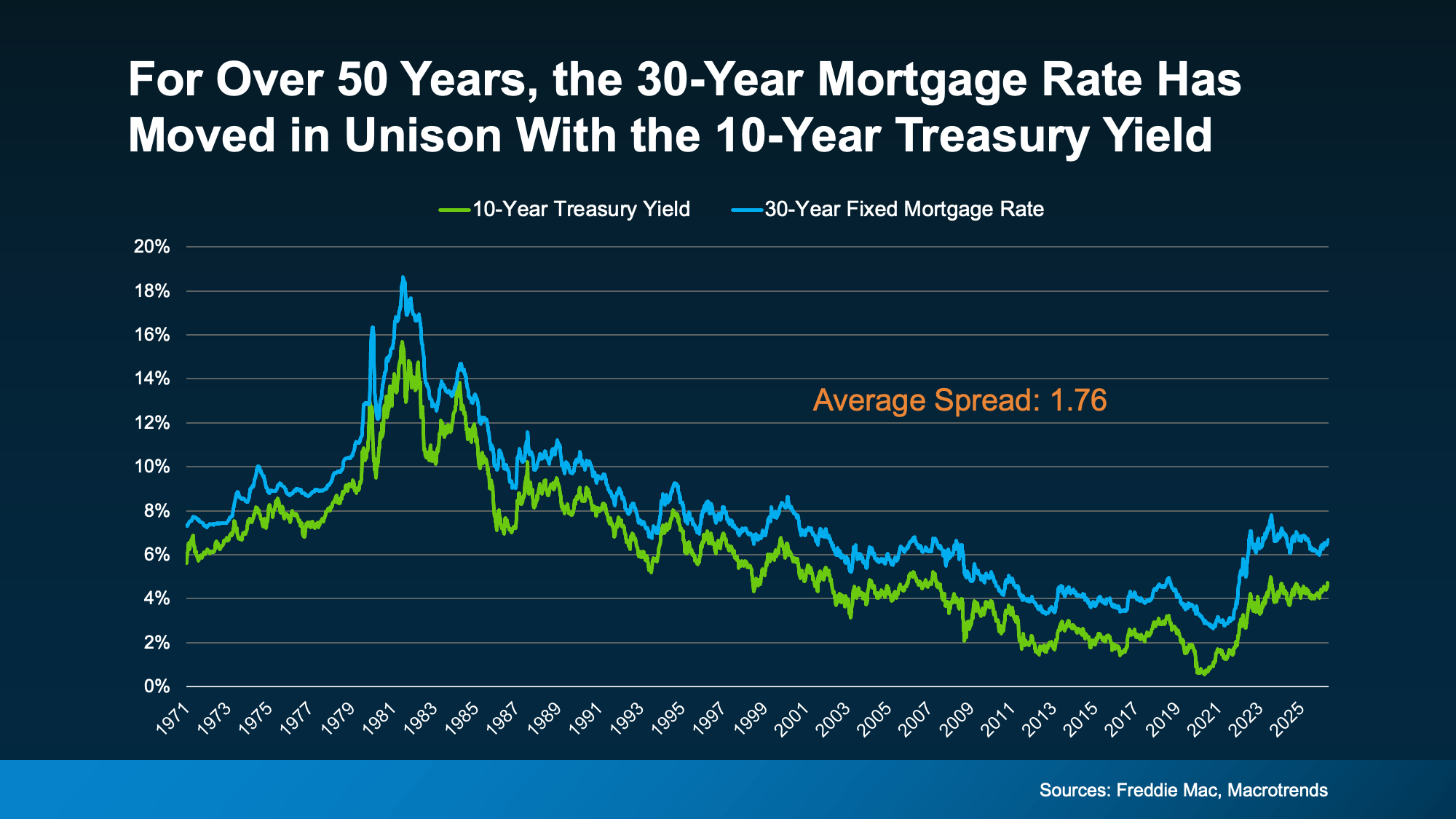
One of the biggest benchmarks they tend to follow is the 10-year Treasury yield, which reflects how investors view the economy, inflation, and future interest rates.
It isn’t a perfect one-to-one relationship. Other forces influence mortgage rates, too. But over decades, the two have generally moved together.
And that brings us to the spread.
The spread is essentially the difference between the 10-year Treasury yield and the average mortgage rate. Historically, that gap has averaged around 1.76 percentage points.
When the spread is unusually large, mortgage rates can sit much higher than the Treasury yield would suggest. When the spread shrinks, mortgage rates can move closer to their historical relationship with the Treasury.
That difference can have a very real impact on your monthly payment.
Why the Mortgage Spread Matters So Much Right Now
Here’s where things get interesting.
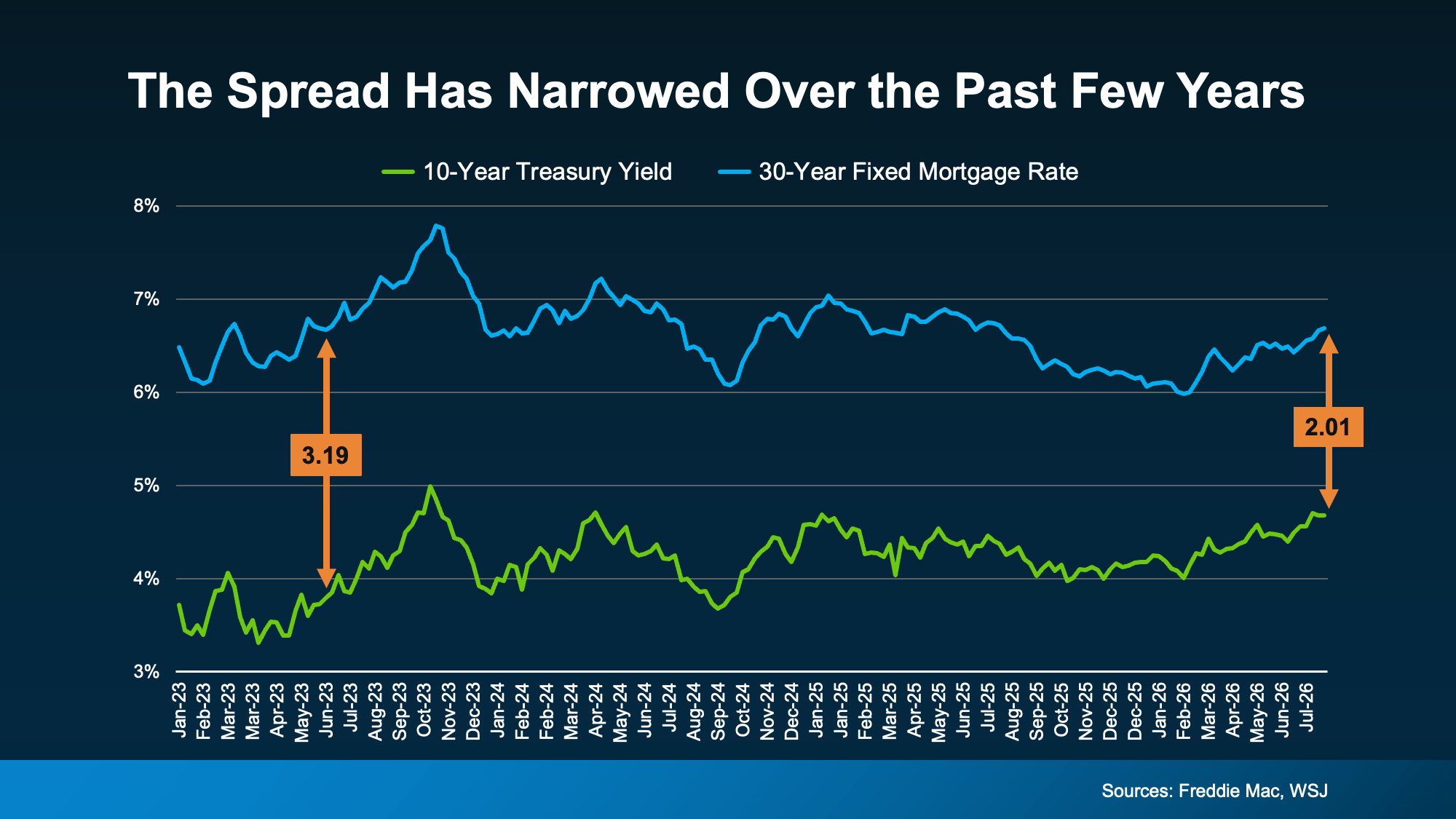
During the uncertainty of recent years, the mortgage spread widened dramatically. In 2023, it climbed as high as roughly 3.19 percentage points.
That was a big deal.
A wider spread essentially added another layer of pressure to mortgage rates, making borrowing more expensive for buyers.
But the spread has improved since then.
It has narrowed to around 2.01 percentage points, which is much closer to its long-term average of 1.76.
That’s good news.
In fact, the narrowing spread is one reason mortgage rates today aren’t significantly higher than they are.
But there’s a catch.
Because the spread has already improved substantially, there may not be nearly as much room left for mortgage rates to fall simply because of spread compression.

Why Waiting for a Huge Rate Drop Could Backfire
This is the part buyers should pay attention to.
Imagine you’re waiting for mortgage rates to drop dramatically before buying. Maybe you’re thinking, “I’ll jump in when rates hit 5%.”
Sounds reasonable, right?
Maybe. But what if rates don’t get there anytime soon?
If you’re waiting for a major rate drop that may take years—or may not happen at all—you could miss opportunities available in today’s market.
And there’s another piece to consider: home prices and competition can change while you wait.
If rates eventually decline significantly, more buyers could come back into the market. That can increase competition and put upward pressure on home prices.
So, you could potentially get a lower mortgage rate while paying more for the house.
That’s why buying a home isn’t simply a game of “wait for the lowest rate.”
It’s about looking at the entire financial picture.
Today’s Rates Could Be Better Than They Look
Let’s put the spread into perspective.
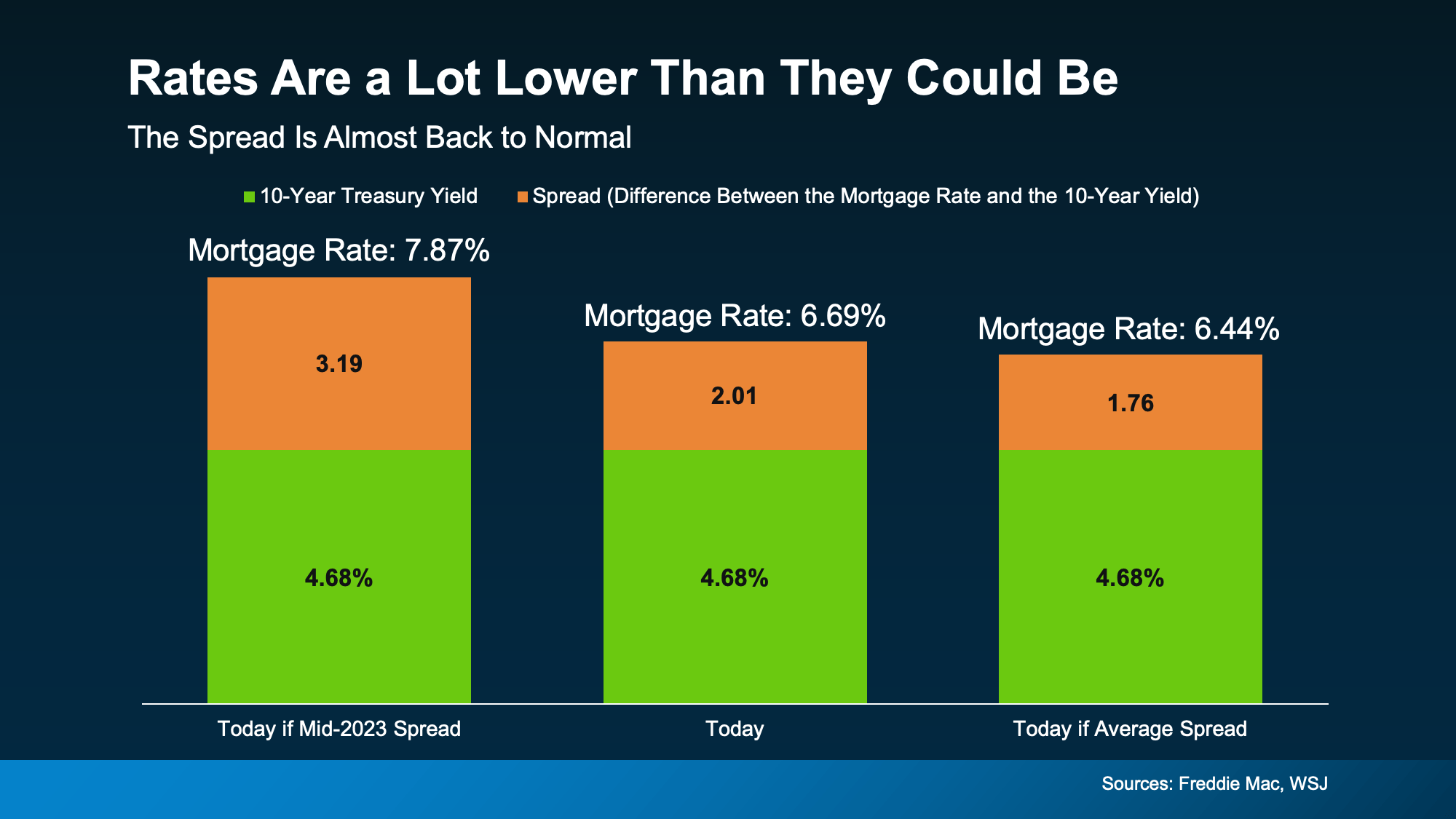
Using a 10-year Treasury yield around 4.68%, different spread scenarios can produce dramatically different mortgage rates.
If the spread were still as high as it was during the worst of 2023, mortgage rates could be pushing toward 8%.
Instead, with the spread closer to 2 percentage points, mortgage rates are around the mid-to-high 6% range in the scenario described above.
And if the spread returned completely to its long-term average of approximately 1.76 percentage points, mortgage rates could be around 6.5% based on that same Treasury yield.
That’s only about a quarter-point difference from the roughly 6.69% scenario.
In other words, much of the improvement we could realistically expect from a narrowing spread has already happened.
The same thing that helped keep rates from being much higher is also limiting how much further they may fall through spread improvement alone.
What Does This Mean for Homebuyers?
It means you shouldn’t make your entire homebuying strategy around guessing where mortgage rates will be six months from now.
Instead, ask better questions:
What would my monthly payment be today?
How much home can I comfortably afford?
What loan programs are available to me?
Could I refinance later if rates improve?
What homes are available in my price range right now?
Those questions give you something you can actually work with.
Nobody has a crystal ball for mortgage rates. Even economists and financial markets can get surprised. But you can control your budget, your timing, your negotiating strategy, and the type of property you pursue.
The Real Estate Market Rewards Prepared Buyers
Here’s the bigger picture: you don’t necessarily need perfect mortgage rates to make a smart real estate move.
You need the right property, the right numbers, and a strategy that fits your financial situation.
If the perfect rate comes along later, refinancing may be an option depending on market conditions and your circumstances. But you can’t refinance a home you never bought—and you can’t go back in time to negotiate on a property that sold while you were waiting.
That doesn’t mean you should rush into a purchase.
It means you should understand your options before deciding that “I’ll wait for rates to drop” is automatically the best strategy.
Bottom Line: Don’t Let One Number Make the Decision for You
Mortgage rates are influenced by much more than headlines. The relationship between the 10-year Treasury yield and the mortgage spread helps explain why rates are where they are—and why a dramatic drop may not be right around the corner.
The encouraging part? The spread has already improved significantly, helping keep today’s mortgage rates lower than they could have been.
So instead of waiting indefinitely for the “perfect” rate, look at the complete picture. A smart real estate decision is about more than the interest rate—it’s about affordability, inventory, price, negotiation, and your long-term goals.
Call or text us at 855-935-MORE. We’d be happy to help you make sense of the numbers and connect you with the right local resources.
Check out this article next