



Before tapping into your 401(k) for a down payment, make sure you’re looking at the right homes and getting the best information possible. Download the Made 4 More app for accurate listings—without your info being sold—so you can find the right home, compare your options, and buy with confidence. Get started today!
You’ve been saving for years. Your 401(k) balance finally looks impressive. Then you find the perfect home—and suddenly, that retirement account starts looking like a down-payment fund.
But should it?
With home affordability still challenging for many buyers, using retirement savings to purchase a home can sound tempting. After all, why wait years to save for a down payment when you already have money sitting in an account?
Here’s the catch: your 401(k) was designed to help fund your future—not necessarily your next house.
That doesn’t automatically mean using it is a bad idea. It means you need to understand the potential costs, risks, and alternatives before moving money around.
Why Your 401(k) Can Look Like the Easy Answer
For many Americans, a 401(k) represents one of their largest financial assets. After years of contributions, employer matches, and investment growth, seeing a six-figure balance can make the idea of using a portion of it feel reasonable.
And when you’re trying to come up with a down payment, that money can feel like a shortcut.
But remember: there’s a difference between having money and having money available without consequences.
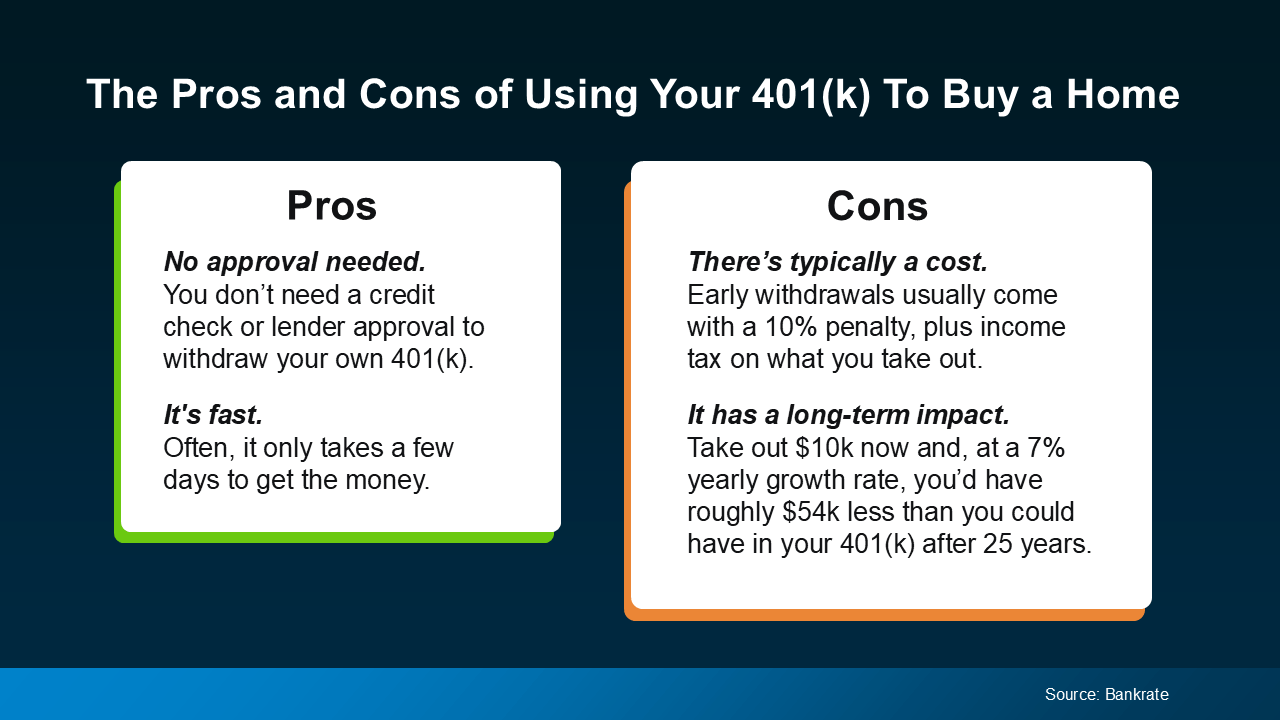
Depending on your situation and your plan’s rules, accessing retirement funds may involve taxes, penalties, repayment requirements, or lost investment growth.
That last one is easy to overlook.
Money you take out today is money that may no longer be invested and growing for your retirement tomorrow.


401(k) Loan vs. Early Withdrawal: They Aren’t the Same Thing
One important distinction is whether you’re considering a 401(k) loan or an early withdrawal.
A 401(k) loan generally allows you to borrow against your retirement balance and repay the money over time, subject to your plan’s rules. An early withdrawal, on the other hand, can trigger income taxes and potentially an additional penalty depending on your age and circumstances.
Neither option should be treated like free money.
Think of your retirement account as a tree you’ve spent years growing. Taking money out today might help you build a house, but you’re also removing some of the branches that could have produced growth for decades.
Before making a decision, talk with a qualified financial or tax professional who can look at your specific situation.
Could Using Retirement Savings Set You Back Later?
This is the question many buyers forget to ask.
You may successfully use your 401(k) to get into a home—but what happens to your retirement plan afterward?
Consider:
- How much retirement growth could you miss?
- Will taxes or penalties apply?
- If you’re taking a loan, can you comfortably make the repayments?
- What happens if you change jobs?
- Will using retirement funds leave you with too little emergency savings?
- Are you putting too much of your financial net worth into your home?
Homeownership can be a powerful wealth-building tool, but you don’t want to solve one financial problem by creating another.
Before Touching Your 401(k), Explore These Options
Your retirement account isn’t your only possible source of down-payment help.
Low-Down-Payment Mortgage Programs
Depending on your qualifications, loan programs may allow you to purchase with a smaller down payment than you expected.
For some buyers, putting less money down can make homeownership possible while keeping retirement savings invested.
Down Payment Assistance
There are national, state, and local programs that may help eligible buyers with down payments or closing costs.
The key word is eligible. Programs have different income, credit, location, property, and other requirements, so it’s worth researching what’s available before assuming you don’t qualify.
Seller Concessions
In some transactions, buyers may be able to negotiate for the seller to contribute toward certain allowable closing costs, depending on the loan type and applicable rules.
That doesn’t eliminate the down payment, but it could reduce the amount of cash you need to bring to closing.
A Different Price Point
Sometimes the simplest solution is also the most overlooked.
What if you adjusted your target purchase price?
A slightly less expensive home could reduce the amount needed for the down payment and potentially lower your monthly payment, taxes, insurance, and other ownership costs.
The goal isn’t simply to buy a house. It’s to buy a house you can comfortably afford.
Run the Numbers Before You Run to Your 401(k)
Buying a home is a big financial decision. Don’t let the excitement of finding “the one” push you into making a rushed move.
Before touching your retirement savings, build a complete picture of the purchase.
Look at your:
Down payment + closing costs + monthly payment + emergency savings + retirement goals
Then compare that with your other financing options.
Your real estate agent can help you understand the purchase side of the equation, while your lender can explain available financing options. A financial or tax professional can help you evaluate the potential impact on your retirement and taxes.
You don’t need one person to answer every question. You need the right team asking the right questions.
The Bottom Line: Don’t Trade Tomorrow for Today
Using your 401(k) to help buy a home may be an option for some buyers, but it shouldn’t be your first move simply because the money is there.
Before withdrawing or borrowing from your retirement account, explore low-down-payment financing, down-payment assistance, seller concessions, and other strategies. Then talk with qualified financial and tax professionals about the potential long-term impact.
The best home purchase isn’t just the one you can get into. It’s the one you can afford to stay in—without putting your financial future at risk.
📲 Ready to talk about your options? Call or text us at 855-935-MORE.
Check out this article next