


🏡 Looking for a multi-generational home? Don’t let bad data or hidden fees get in the way of finding the right home for your family! Download the Made 4 More app for the most accurate listings—without your info being sold. Find homes with the space, flexibility, and features your family needs with confidence. Get started today!
That spare bedroom on the main floor. The finished basement with a kitchenette. The bonus room you’ve been using to store holiday decorations.
To you, it might just be extra space. To the right buyer, it could be the feature that makes your home stand out—and potentially command a premium.
Why? Multi-generational living is becoming a bigger part of the housing market.
More Families Are Sharing One Roof
The traditional idea of a household is changing. More families are combining generations under one roof to make housing costs more manageable, provide care for aging parents, or simply stay closer as a family.
According to Realtor.com, the number of multi-generational households increased from about 3.2 million to nearly 4 million between 2014 and 2024.
That’s a significant shift. And when more buyers need a particular type of home, properties that already have those features can become especially attractive.
Think of it like this: A standard three-bedroom home might check plenty of boxes. But a home with a private bedroom and bathroom downstairs, a second kitchen, or a separate entrance? Suddenly, it can solve a much bigger problem.

Extra Space Can Be a Major Selling Point
For a growing family, an in-law suite isn’t just another room. It could mean privacy for grandparents.
A finished basement isn’t simply additional square footage. It could become a private living area for an adult child.
A bonus room isn’t wasted space. It could be an office, playroom, guest suite, or another bedroom.
The value isn’t always in the room itself. It’s in what the room makes possible.
That’s an important distinction for homeowners thinking about selling. Buyers aren’t just looking at how many square feet they get. They’re asking themselves, “Can this house actually work for my family?”
If the answer is yes, you’ve got something powerful.
Multi-Generational Homes Can Command a Premium
And buyers are putting their money behind that demand.
Realtor.com reported that in 2025, the median asking price for a multi-generational home was around $709,000, compared with approximately $429,900 for a standard home.
Of course, larger homes naturally tend to cost more. But even when comparing homes with similar square footage, multi-generational properties can still stand apart.
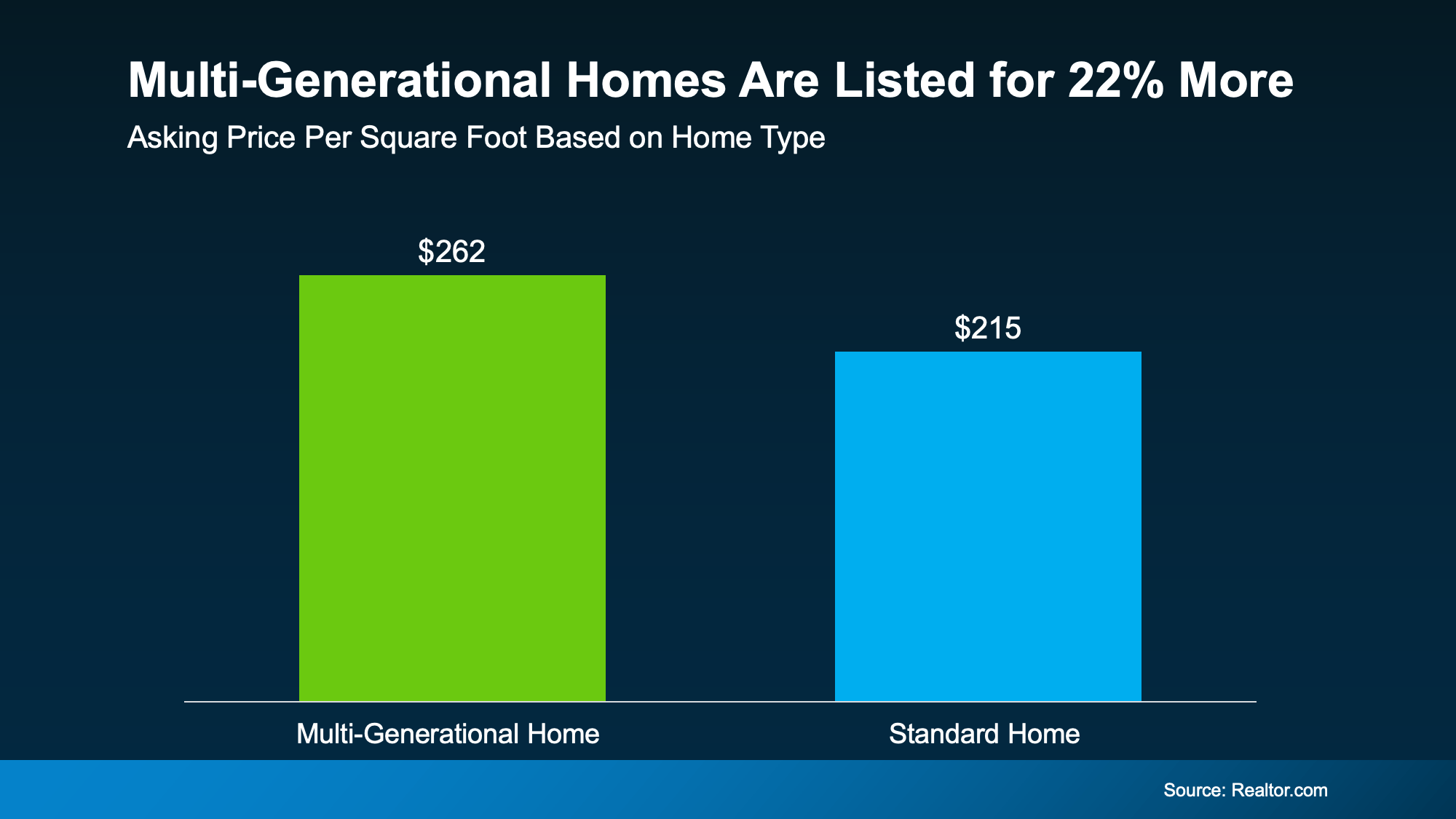
The same Realtor.com data showed multi-generational homes at roughly $262 per square foot versus $215 per square foot for standard homes.
That’s about a 22% premium per square foot.
Features such as in-law suites, additional kitchens, separate entrances, multiple primary suites, and flexible living areas can make a home particularly appealing to buyers looking for a multi-generational setup.
That doesn’t mean every home with a spare bedroom automatically deserves a higher price. Location, condition, layout, upgrades, and comparable sales still matter. But it does mean the right features deserve to be marketed—not buried in the listing description.
Buyers Are Looking for These Homes
Here’s another reason sellers should pay attention.
Multi-generational homes aren’t necessarily sitting on the market longer just because they’re priced higher.
Realtor.com reported that these homes received 13.5% more online views than standard homes while selling in roughly the same amount of time—about 59 days.
That’s a pretty telling combination.
More attention + strong demand + limited inventory = a property that can stand out.
And that’s exactly where strategic real estate marketing matters.
If your home has a separate entrance, second kitchen, downstairs bedroom, private living area, or other multi-generational features, don’t assume buyers will automatically notice them. Show them. Explain how they can be used. And position the home around the lifestyle it can provide.
Your “Extra” Room Could Be the Selling Feature
This is where homeowners sometimes leave money on the table.
You may see a basement.
A buyer may see independence for their parents.
You may see a spare bedroom.
A buyer may see a comfortable space for an adult child.
You may see an old bonus room.
A buyer may see the home office they’ve been searching for.
Same house. Completely different perspective.
That’s why understanding today’s buyer matters so much when you’re preparing to sell. The features that seemed ordinary a few years ago may have a completely different value in today’s market.
Thinking About Selling? Start With What Makes Your Home Different
Before you decide what your home is worth, take a fresh look at what it offers.
Does it accommodate multiple generations? Does it have flexible spaces? Could a basement function as a separate living area? Is there a private entrance? Are there multiple bedrooms and bathrooms that give everyone a little breathing room?
These aren’t just checkboxes. They can be powerful selling points when they’re properly presented.
And here’s the bigger takeaway: the best buyer for your home may not be looking for the biggest house—they may be looking for the right house.
If your property solves a specific problem for a buyer, that’s an advantage worth highlighting.
Bottom Line
Multi-generational living is creating a growing pool of buyers who need homes that can do more. If your house offers flexible living spaces, private areas, separate entrances, or other multi-generational-friendly features, you may have more buyer appeal than you realize.
The key is knowing what those features are worth in your local market—and how to market them effectively.
Call or text us at 855-935-MORE to find out how your home’s unique features could affect its value and buyer demand.
Check out this article next